
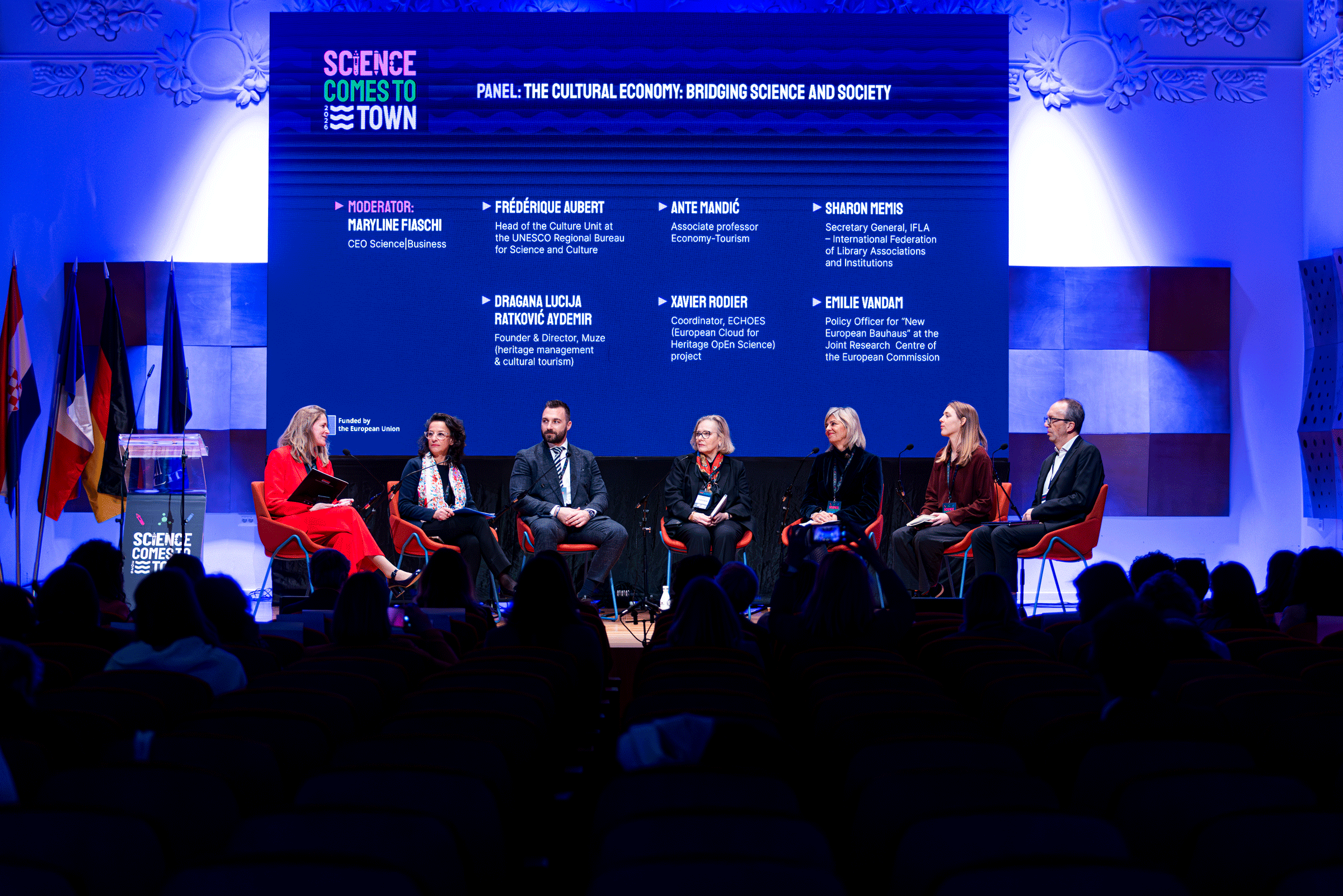
The CEO of Muses, Dragana Lucija Ratković Aydemir, took part in the official opening of the international project Science Comes to Town, funded through the Horizon Europe programme, on 20 January 2026 in Split. The project connects the cities of Split, Kiel and Brest, together with more than 70 European partners, with the aim of bringing science closer to citizens, strengthening dialogue between science, public policy and society, and encouraging scientific and research careers among younger generations.
The opening began with an international conference held at the Croatian Home in Split, bringing together representatives of European cities, universities and European and international institutions, including representatives of the European Commission. The programme included panel discussions focused on the role of cities in the development of science, innovation and society, and on linking science, culture and the economy.
Dragana contributed to the panel Cultural Economy: Connecting Science and Society, alongside international experts from the fields of culture, science, heritage and innovation. In the discussion, she emphasised the importance of heritage interpretation, cultural tourism and the cultural economy as spaces in which scientific knowledge can be translated into accessible, relevant and socially meaningful content for wider audiences, and as a key bridge between scientific communities, local authorities and citizens.
Muses are proud to be part of this project and to contribute to discussions at the European level on issues that shape the future relationship between science, culture and society. Participation in the opening of Science Comes to Town confirms Muses’ commitment to an active role in international dialogues and to the development of models that make scientific and research knowledge accessible, understandable and meaningful in both local and European contexts.
Throughout 2026, the Science Comes to Town project will deliver a rich programme of parallel activities in Split, Kiel and Brest, with a focus on knowledge exchange, collaboration between scientists, cities and cultural actors, and the creation of long-term impact that extends beyond the project’s implementation year.


